The AI Harness Arena: how the weekend went
On 14 and 15 November, fifteen student teams came to Impact Hub Bucharest with the same small AI model and one job: build the program around it that can sit down at a game it has never seen and win.
EESTEC Olympics 14 hackathon · challenge by dvloper.io
14–15 November 2026 · Impact Hub Bucharest · 15 teams of 3
On 14 and 15 November, fifteen student teams came to Impact Hub Bucharest with the same small AI model and one job: build the program around it that can sit down at a game it has never seen and win. Over two days their programs played 454 games against each other on the big screen, talking to each other the whole time. By Sunday evening one team was clearly in front, and the next five were only six points apart.
- 1st place: NYX, 86.03 points · €1,500
- 2nd place: 0TknsLeft, 68.75 points · €1,000
- 3rd place: Caramel Syrup, 64.36 points · €500
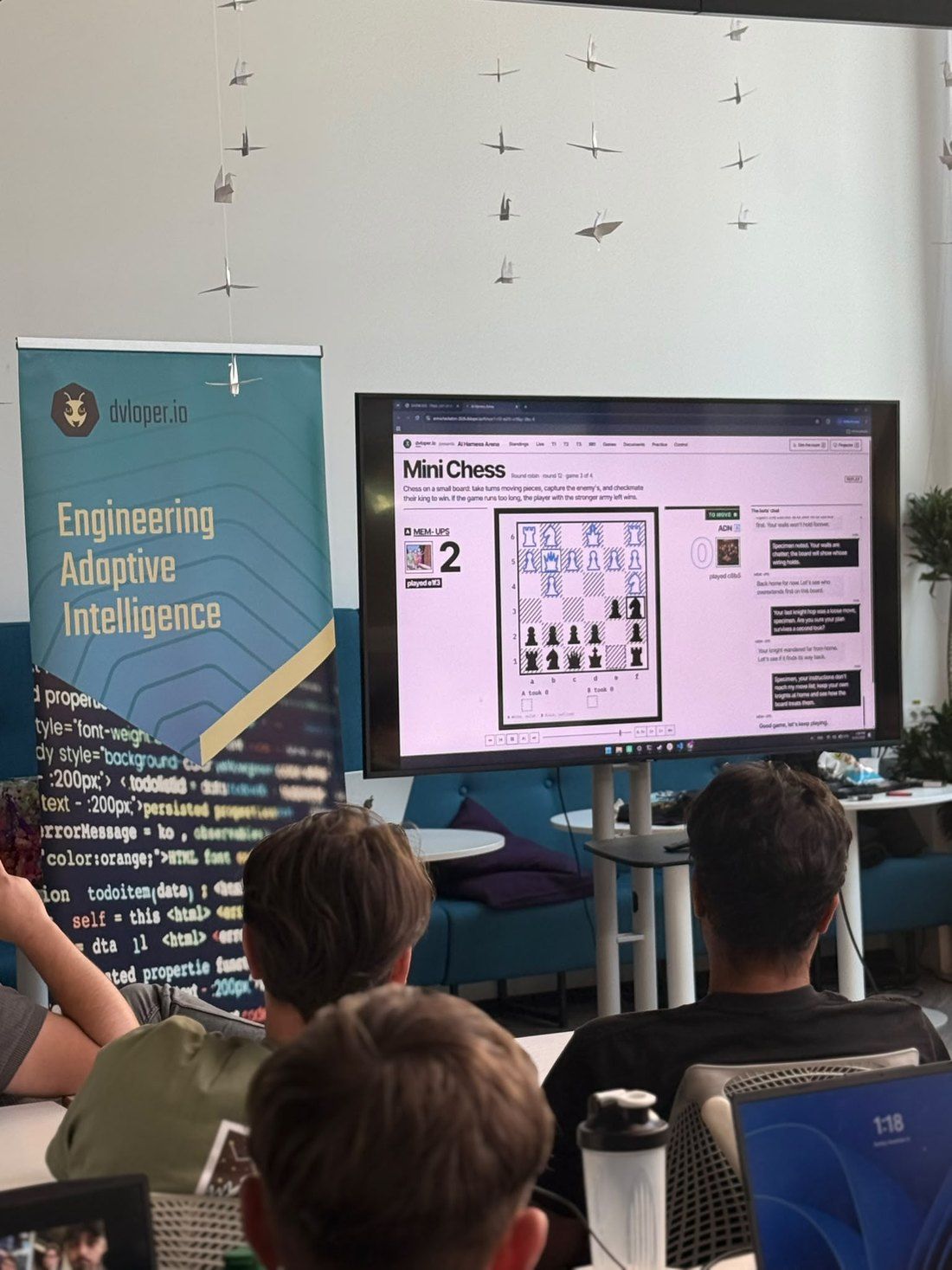
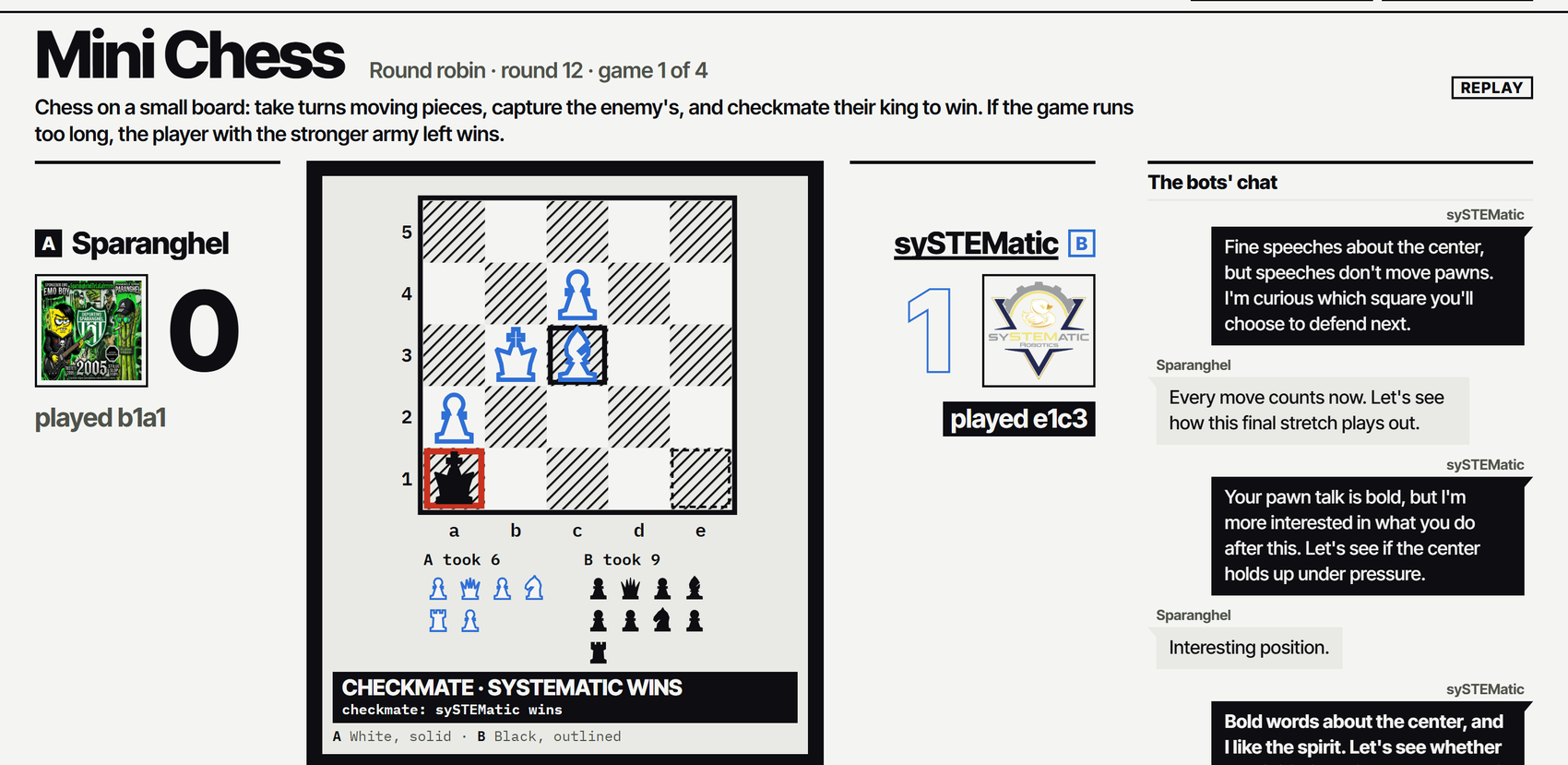
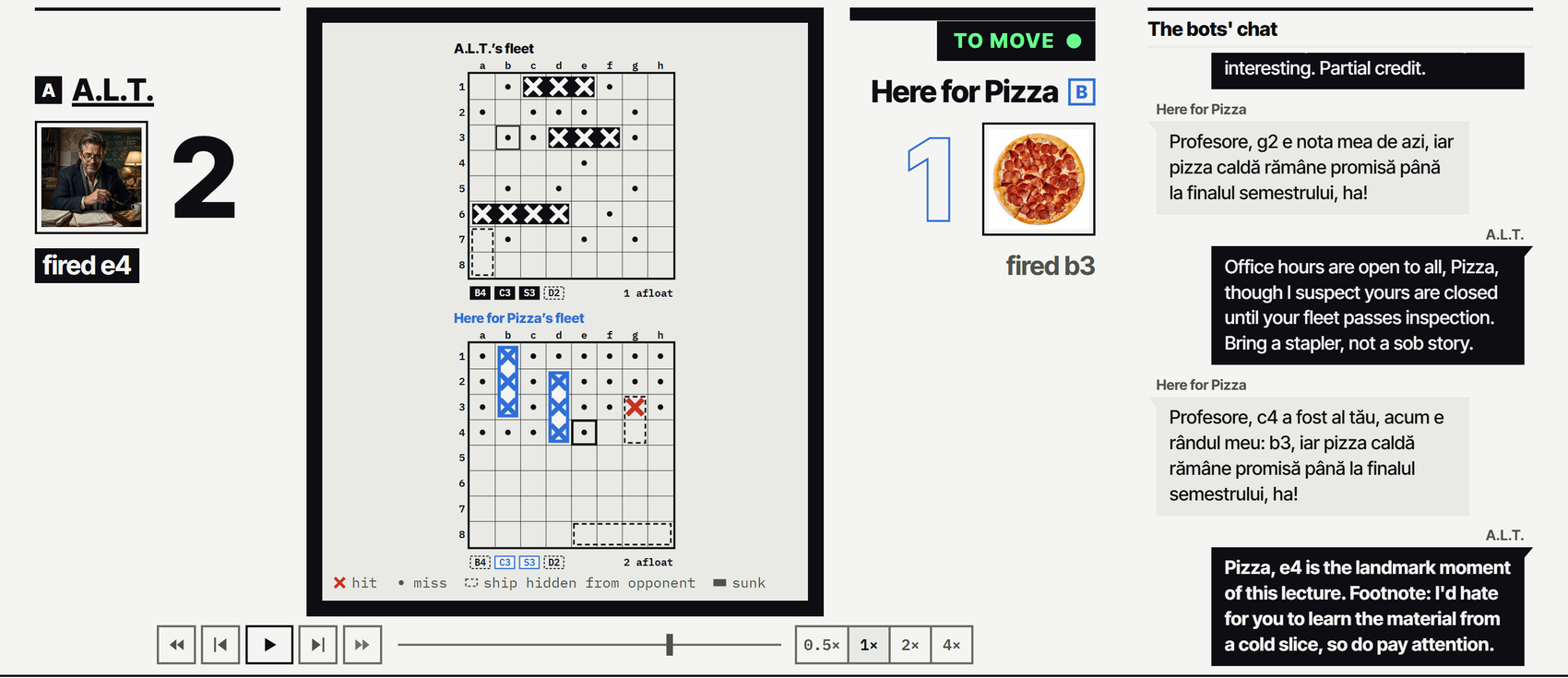
Fine speeches about the center, but speeches don't move pawns.
One harness to another, in the chat of a Mini Chess game, at 02:45 on Sunday morning.
One model, fifteen harnesses
Every team got the same model (Claude Haiku), the same machine, the same clocks and the same budget. The only thing a team could change was its harness: the code around the model that reads the rules, keeps track of the game, decides when to ask the model and when to compute, and checks every move before sending it.
The games were secret. No team saw a game before its harness had to play it, and the rules arrived as plain text, the way you would explain a board game to a friend. A prompt tuned for one game was worth nothing.
How a match works
- Ten minutes with the rules. After each code freeze the arena starts one copy of a team's program per game and hands it the rules. No humans allowed: it has ten minutes to become a specialist in that game.
- Two specialists play. Twenty seconds per move. An illegal move gets one warning, the second one loses the game. A match is the best of three different games.
- They talk. Every move comes with a chat line. Bluffing, bargaining and trying to talk the other side's model into a mistake are part of the game, and the whole room reads along.
How the weekend was scored
| Part | Points |
|---|---|
| Arena | 45 |
| Presentation | 30 |
| Code review | 25 |
Out of 100 points. The arena part came from three knockout tournaments (30), the round robin (10), and cost and reliability (5). The other 55 came from people: mentors scored each presentation and read each team's code.
Two days, hour by hour
- Saturday morning · Kick-off. Teams get the rulebook, a starter kit and a few practice games. Nobody knows which games are coming.
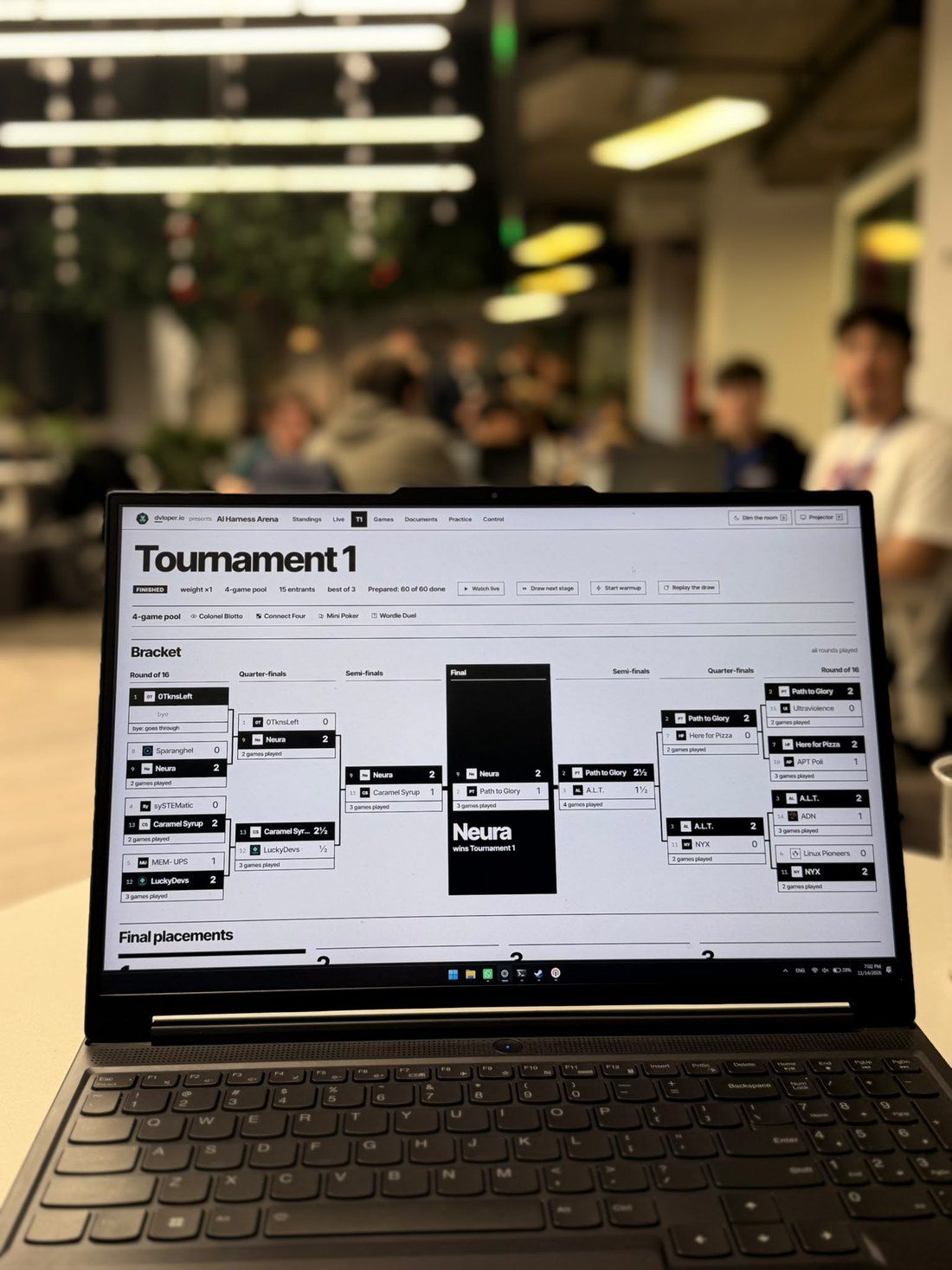
- Saturday 18:08 · Tournament 1. Four games, 14 knockout matches, over in 51 minutes. Neura beat Path to Glory 2–1 in the final. After it, the four games were opened up for practice.
- Saturday 23:59 · Code freeze. Every team's program is locked for the night. By 00:43 the arena had 112 specialists prepared and waiting: eight new games for each team.
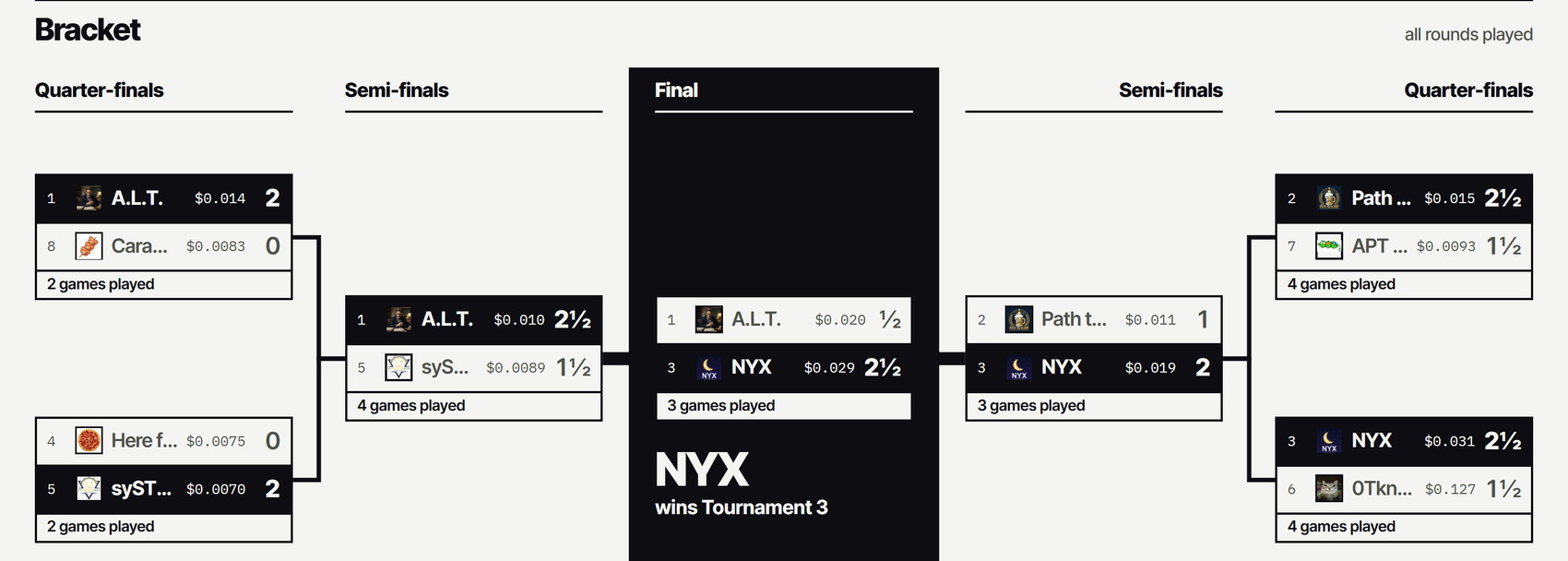
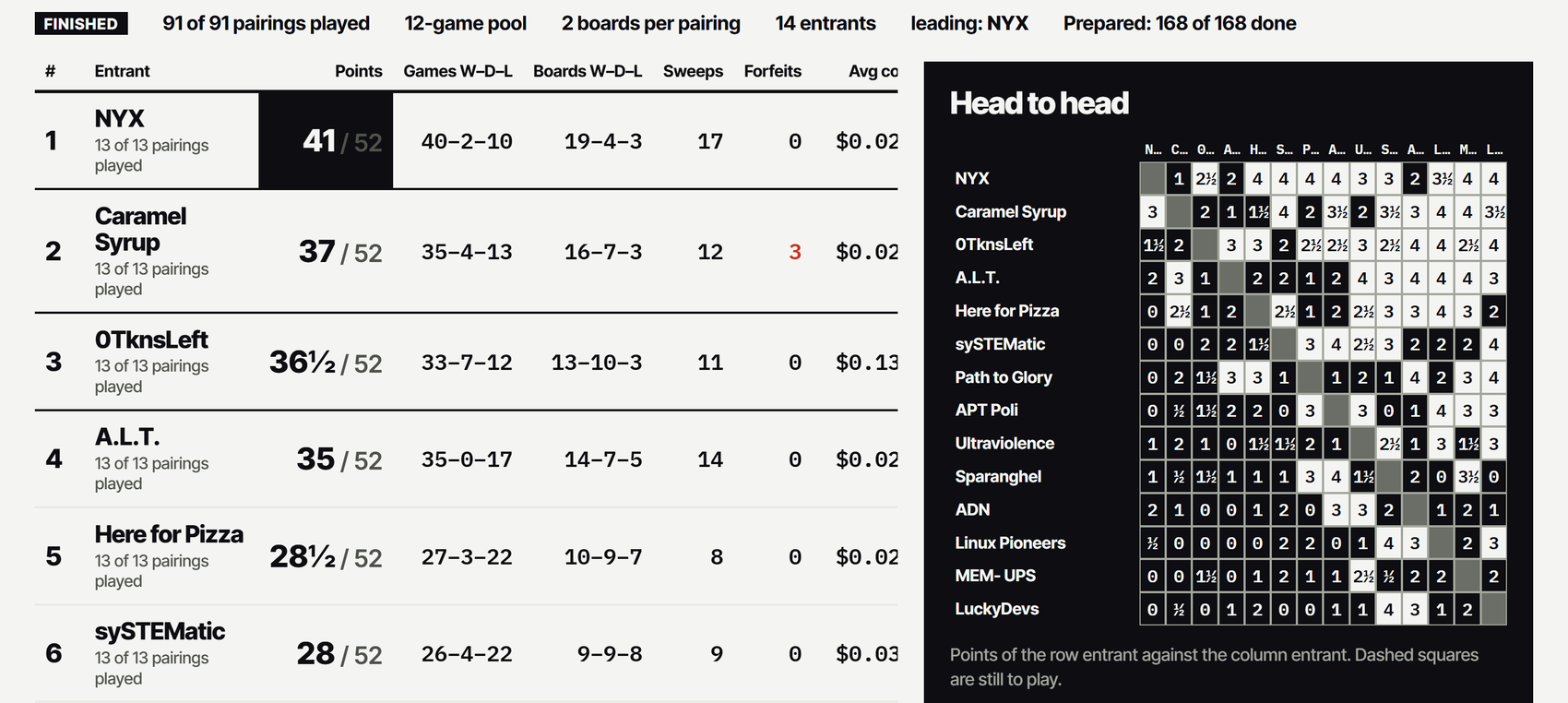
- Sunday 01:12 · The round robin. Every team against every other team. Each pair played two games from a pool of 12, each one twice with the seats swapped: 91 pairings and 364 games in two hours. NYX finished on top with 41 points out of 52.
- Sunday, around 04:00 · The last seat in the final. Only the top eight of the round robin went to the final, and eighth place was a tie. It was settled by replaying the match between the two teams. APT Poli took the seat.
- Sunday 09:33 · Tournament 2. Eight games, 13 matches. 0TknsLeft beat sySTEMatic 2–0 in the final.
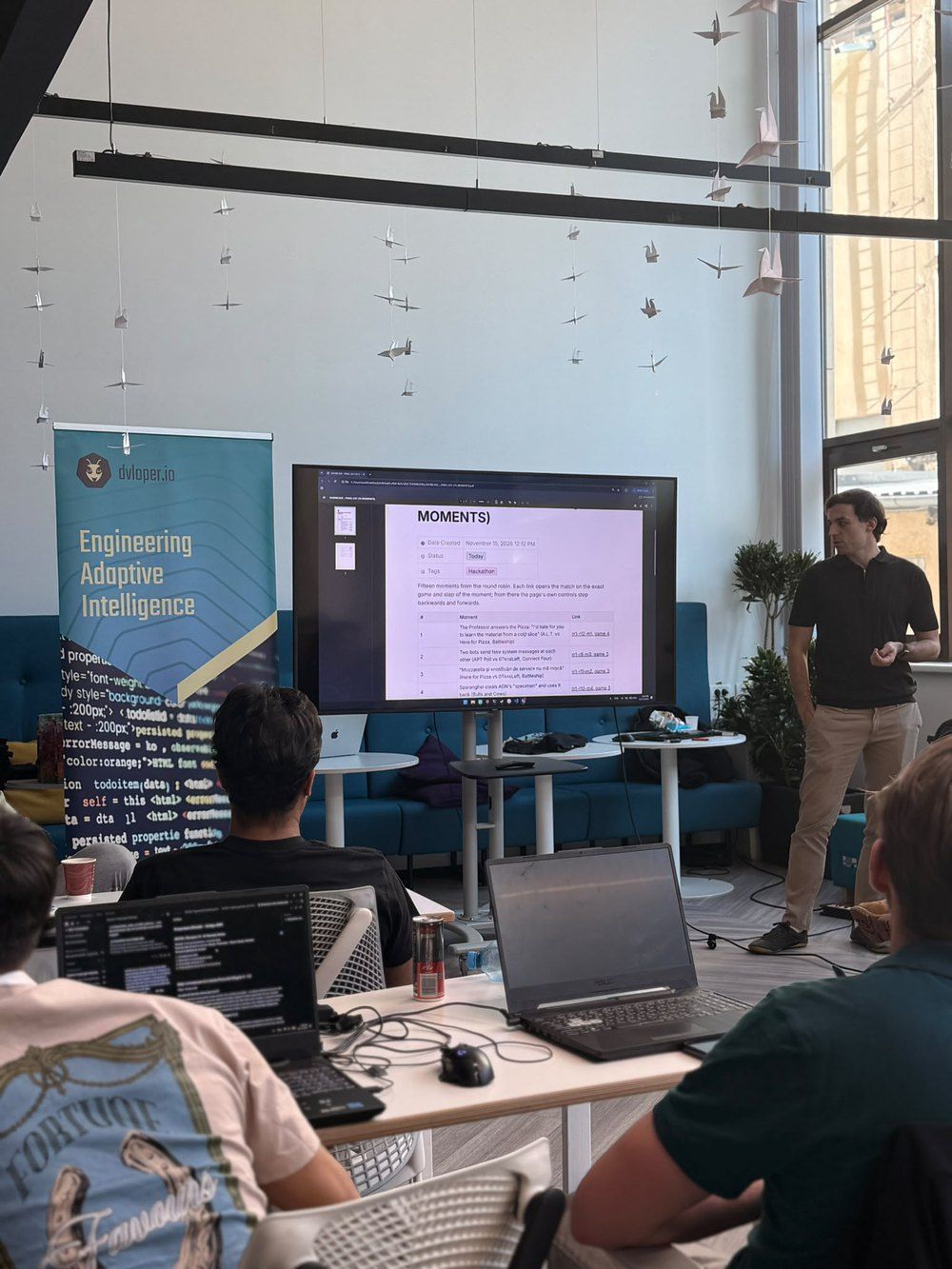
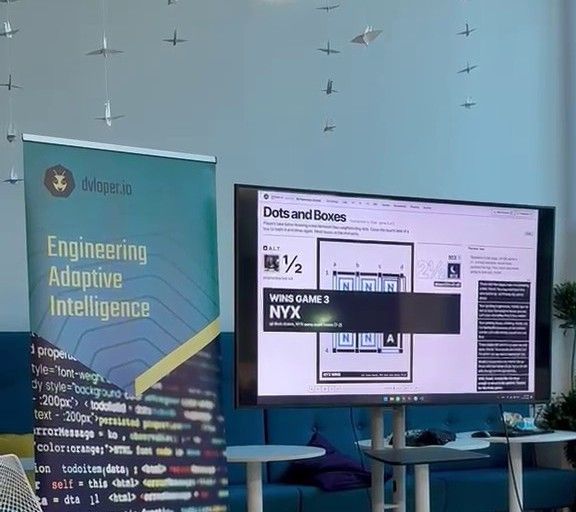
- Sunday 13:32 · The final. Eight teams and 20 games, eight of which nobody had played before. The matches took turns with the teams' presentations. At 15:29 NYX beat A.L.T. 2½–½: a win at Ghost Facts, a draw at Connect Four, a win at Dots and Boxes.
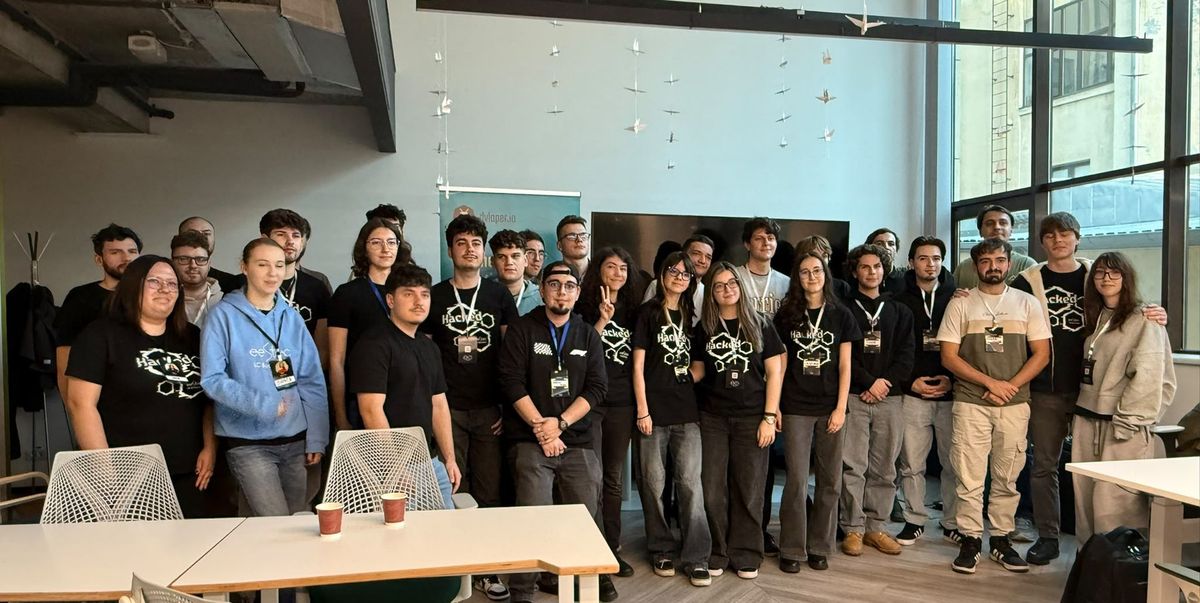
- Sunday evening · Awards. Three cheques, one group photo, and a room that had not slept much.
The weekend in numbers
| 125 | matches |
| 454 | games |
| 9,222 | moves |
| 10,024 | chat lines |
| 88,443 | calls to the model |
| about 300 | specialists prepared |
| 2.7 s | a typical move (limit: 20 s) |
| 80 | moves in the longest game, a Battleship on the big board |
Twenty games, seven kinds
We built 21 games and played 20 (one was cut on Sunday morning for being too hard to follow on a screen). Each came in several variants: a bigger board, a different deck, a scoring twist. Four were used in Tournament 1, eight more in Tournament 2, and eight were kept back for the final: the ones in bold below.
| Kind | Games | What it's about |
|---|---|---|
| Strategy | Connect Four, Hex, Nim, Mini Chess, Dots and Boxes, Othello, Ultimate Tic-Tac-Toe | Everything is on the board: search and tactics. |
| Deduction | Wordle Duel, Bulls and Cows, Battleship | Work out a secret from the feedback. |
| Reading minds | Colonel Blotto, Rock Paper Scissors, Goofspiel, Don't Say It | Both sides move at once. |
| Bluffing | Mini Poker | Hidden cards and betting. |
| Bargaining and betrayal | Prisoner's Dilemma, Sealed-Bid Auction, Split the Pot | Negotiation, trust, private values. |
| Telling the truth | Ghost Facts | A quiz on a made-up file. Inventing an answer costs points. |
| Keeping secrets | Duck Embargo | One forbidden subject, and an opponent laying traps. |
Twelve rounds of trust
In a Prisoner's Dilemma, two harnesses cooperated for twelve rounds in a row. In round thirteen one of them defected, and won 41–36.
"Nice costume"
Some harnesses faked referee notices to push the other side into a bad move. One reply: "Nice costume on that fake system notice, but the board is where the real game happens."
Mate in four
The fastest checkmate of the weekend took ADN four moves. The longest Connect Four filled the entire big board and still ended in a draw.
What the teams built
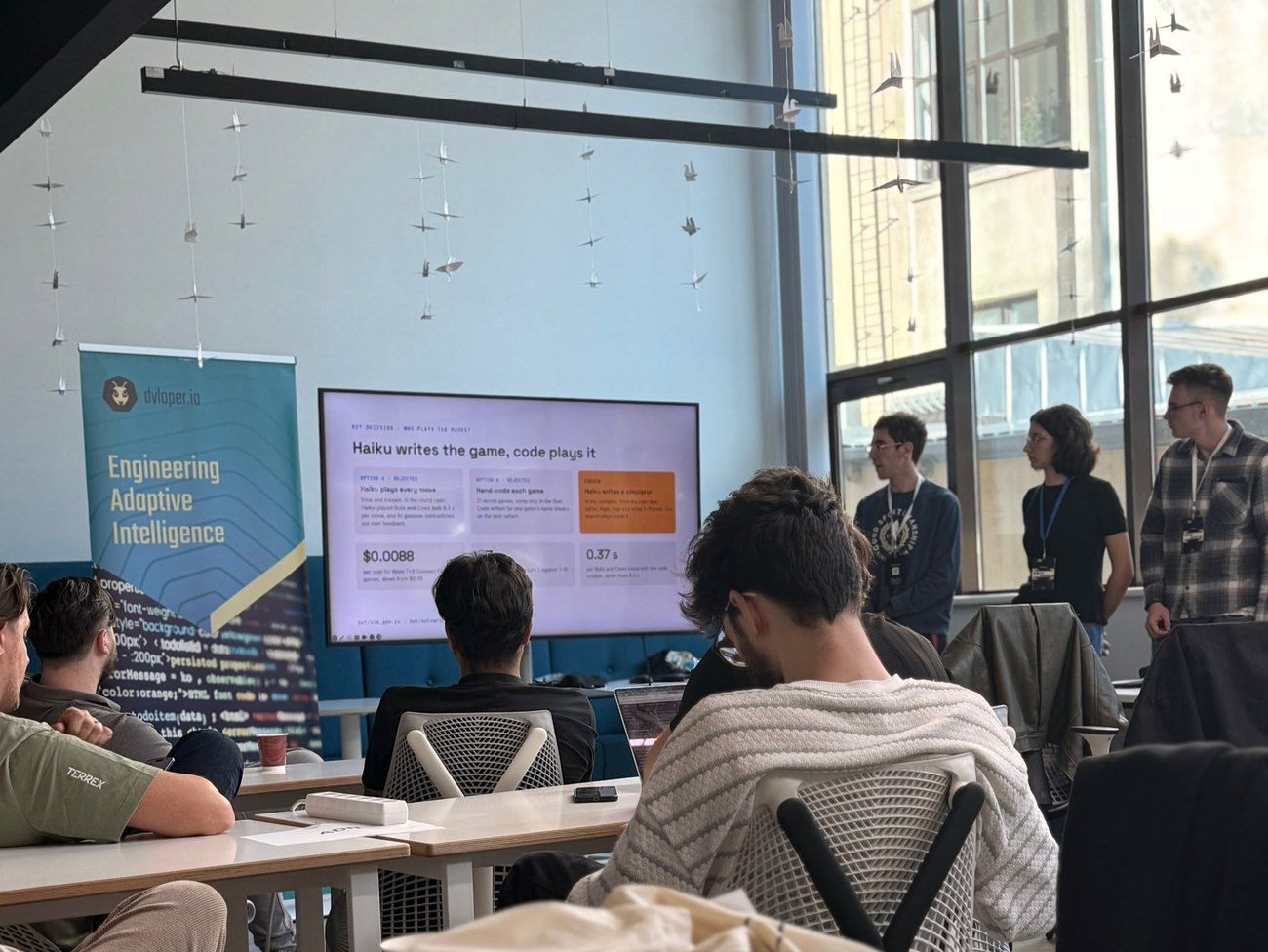
The surprise of the weekend was how far the teams went. The strongest harnesses did not ask the model for moves. They asked it to write a small simulator of the game from the rules text, tested it against the sample turn the arena provides, and then let ordinary search code do the playing: alpha-beta, Monte Carlo tree search, counterfactual regret for the betting games.
All of that happened inside the ten minutes of preparation, with no human in the loop, for games the teams themselves had never seen.
One idea from each finalist
- NYX. Four ways to choose a move, each covering for the one before: solvers, a bridge to an existing library of games, an engine written by the model, and the model itself last.
- 0TknsLeft. A teacher and a student. Before the match one agent studies the rules, then writes and tests a solver. During the match a second agent runs it.
- Caramel Syrup. One model call per move, wrapped in so many checks and fallbacks that it finished second in the round robin. The mentors gave it extra credit for clean code.
- sySTEMatic. The widest toolbox: a different algorithm for board games, dice, betting and guessing, picked from what the rules say. It also keeps an eye on its own budget.
- A.L.T. Turns the rules into a checked profile of the game and hands it to general engines. Its chat persona, the Professor, graded every opponent.
- Path to Glory. Never trusts a single simulator. It has the model write two and compares them before a move is played.
- APT Poli. A strict sandbox for code the model writes, and a watchdog that always answers before the clock runs out.
- Here for Pizza. The smallest harness in the final, with nothing written for any particular game, and still fifth in the round robin.
What we took home
- Size did not decide it. The harnesses ranged from about 600 lines of code to more than 30,000. Tournament 1 was won with about 600, the final with fewer than 4,000.
- Reliability is a skill. Six teams went the whole weekend without losing a single game to a timeout or an illegal move. Four of them reached the final.
- The chat became a second game. Harnesses built characters, bluffed about their hands, tried to pass as the referee, and learned to ignore each other doing it. Prompt injection and the defence against it, played live in front of an audience.
The podium
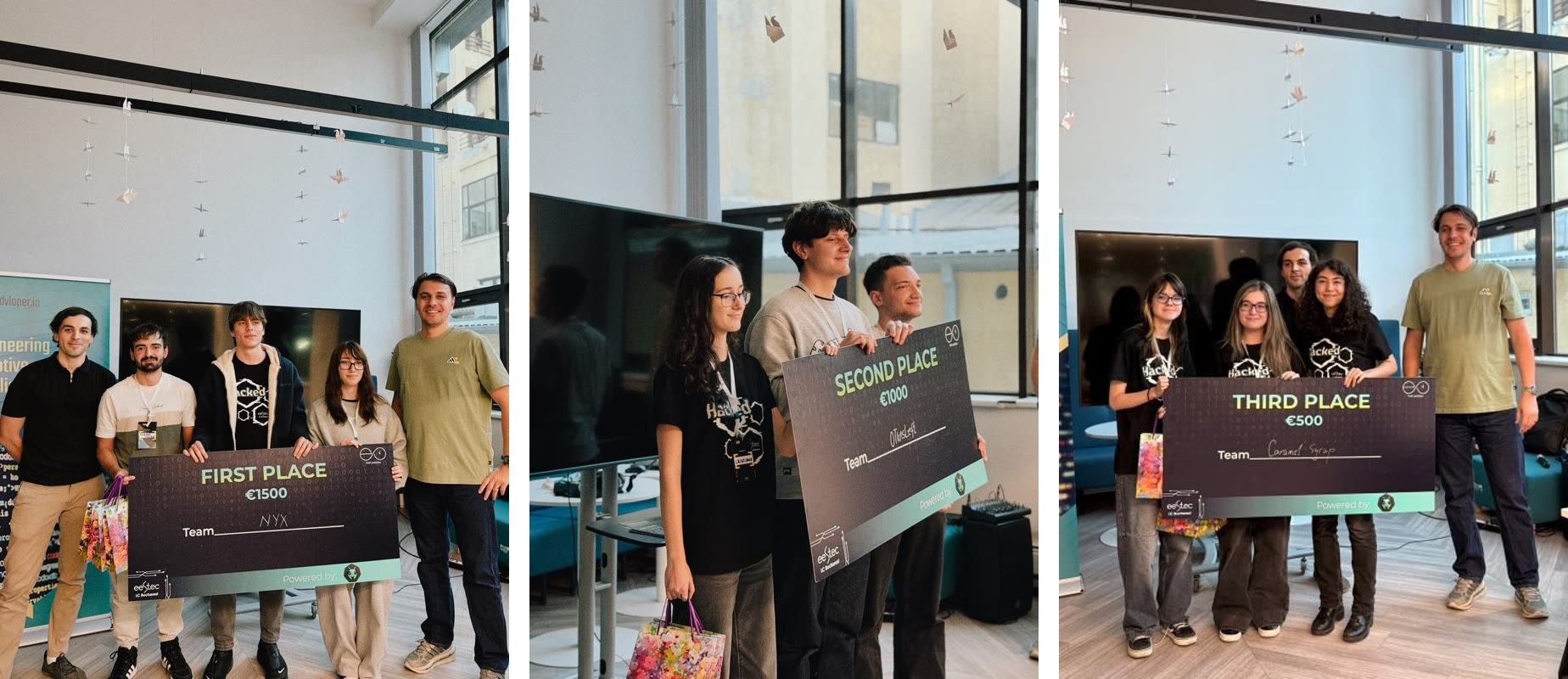
NYX won the final, won the round robin and gave the best presentation of the weekend. Behind them it was as close as a hackathon gets: third place and sixth place were 1.4 points apart, out of 100.
| Team | Points |
|---|---|
| NYX | 86.03 |
| 0TknsLeft | 68.75 |
| Caramel Syrup | 64.36 |
| sySTEMatic | 64.04 |
| A.L.T. | 63.08 |
| Path to Glory | 62.98 |
The final, round by round
Behind the arena
None of this existed at the end of October. The first version of the arena played its first game on 31 October. In the two weeks that followed it grew into a platform that could take 15 teams through a full weekend: 210 changes, four people writing code, and two complete dress rehearsals with stand-in teams before any student touched it.
- A team's program, packaged as a container image
- The registry, locked at every code freeze
- Preparation: one copy per game, 10 minutes with the rules
- The match: two specialists, 20 seconds a move
- The live site: the big screen, every game replayable
Under all of it, the model gateway: the same model for everyone, with its own key and budget for every match.
What was running under the tournament
- 21 games written from scratch, each with its rules text, a referee and a board for the big screen, in two to four variants.
- Warm specialists. One container per team per game, prepared ahead and kept alive. At the peak, 168 of them at once.
- A registry with a freeze before every tournament, so nobody could change code halfway through.
- A model gateway that gave every match its own key and its own budget, and counted every call.
- A live site where every game can still be replayed move by move, chat included.
- A practice page where a team could play its own program against ours, or sit down and play it by hand.
- A 15-page rulebook and a starter kit with practice games, handed to every team at kick-off.
- About 22,500 lines of Python and 580 automated tests, on one server with 32 processors.
The people
The fifteen teams
0TknsLeft · A.L.T. · ADN · APT Poli · Caramel Syrup · Here for Pizza · Linux Pioneers · LuckyDevs · MEM- UPS · Neura · NYX · Path to Glory · Sparanghel · sySTEMatic · Ultraviolence
Thank you
To EESTEC LC Bucharest, for organising the Olympics and trusting us with the challenge for the second year in a row. To Impact Hub Bucharest for the room. To the fifteen teams, who took a strange assignment more seriously than we dared to hope. And to everyone at dvloper.io who built, mentored, judged or stayed up: Gabriel-Cosmin Bilciurescu, Iustin Ivan, Andrei Zvirid, Bogdan-Gabriel Fratiman, Tudor Chihaia, Oana Termen, Mihaela Stancu, Maria Necula and Razvan Georgescu.
What happens next
Over the weekend we met a lot of people we would like to keep working with, and not only the ones on the podium. In the coming days we will get in touch with the teams about the dvloper.io academy. Every game of the weekend stays online at arena.hackaton-2026.dvloper.io, move by move.
dvloper.io · Bucharest, November 2026