Why AI makes developers more important than ever

An opinion piece by Mihai Chihaia, Chief Revenue Officer at dvloper.io
Artificial intelligence is rapidly changing the way software is built. Generative models can now write code, generate tests, document applications, and automate an increasing share of tasks that, until recently, required a developer’s direct involvement.
But if AI can generate code increasingly well and increasingly fast, what role is left for the person who writes it?
In these exceptional circumstances, both in their nature and significance, technical expertise is not becoming less important. Quite the opposite.
As the volume of code we can generate increases, it becomes even more important to have people who can understand what needs to be built, why it should be built in a particular way, and whether what AI has produced is actually correct.
“The problem is not that AI can write code. The problem is that we can now generate a huge amount of code, very quickly. If this process is not governed by people who understand architecture, security, performance, and the long-term implications of technical decisions, we can accumulate technical debt at a much faster rate than before.”
This is one of the major changes AI is bringing to software development. The tools are getting faster, but speed is not necessarily, or always, synonymous with value.
A system can be built faster while also becoming harder to maintain, more vulnerable, or more expensive in the long run. That is why the skills that will matter increasingly are those that allow developers to see the problem end to end.
Understanding business requirements, knowing when to challenge a requirement, choosing the right architecture, assessing security and performance risks, and validating AI-generated outputs are becoming at least as important as writing the code itself.
As code becomes easier to generate, the developer’s value therefore shifts from the ability to write code to the ability to decide what code is worth writing, how it should be built, and whether the outcome is the right one.
This transformation, however, is not limited to technical departments.
Across organizations, the temptation to view AI as a direct substitute for people is growing. Some companies have tried to reduce headcount quickly, assuming that AI agents would be able to take over employees’ work.
In practice, however, the limitations of this approach are becoming apparent. AI is an extremely powerful tool, but its value depends on how it is integrated into the organization.
AI needs context.
To operate effectively within a company, it needs to understand processes, data, the relationships between them, business rules, and the boundaries within which it can make or recommend decisions.
“That is why I believe the real transformation is not ‘humans versus AI,’ but a redesign of how work gets done. Some activities will be automated, others will be augmented by AI, and people’s roles will evolve toward areas where judgment, context, accountability, and creativity remain essential. I do not think the main question should be how many people AI can replace, but what we can build differently when people and AI systems work together.”
In this new context, the software development services market is changing as well.
The traditional model, based largely on the number of people and days required to deliver a project, is being challenged by the productivity gains enabled by AI. We are already seeing, and will increasingly see, hybrid teams in which people work alongside AI agents throughout the development lifecycle, from coding and testing to documentation and code review.
A Technical Lead with strong AI expertise can coordinate not only a team of developers, but also multiple specialized agents.
Under these conditions, the number of man-days no longer necessarily reflects actual delivery capacity. If an activity that previously required several days or several people can be completed much faster with AI, the value of the service can no longer be defined solely by the time spent.
We can therefore expect a shift from capacity-based models toward services evaluated on outcomes and value.
Clients will be less interested in team size and more interested in what a provider can deliver, how quickly it can deliver it, at what level of quality, and with what degree of accountability for the outcome.
The same principle applies at the management level.
Solutions marketed as an “AI CTO,” “AI CFO,” or even “AI CEO” are already appearing on the market. AI can analyze vast amounts of information, quickly identify correlations, build scenarios, and synthesize data in a very short time.
For an executive, these capabilities can radically change how decisions are made.
But leadership is not just about processing information. It means taking responsibility, understanding context, managing people, negotiating conflicting interests, and making decisions when the data is incomplete.
AI can support these processes, but accountability for the decision does not disappear.
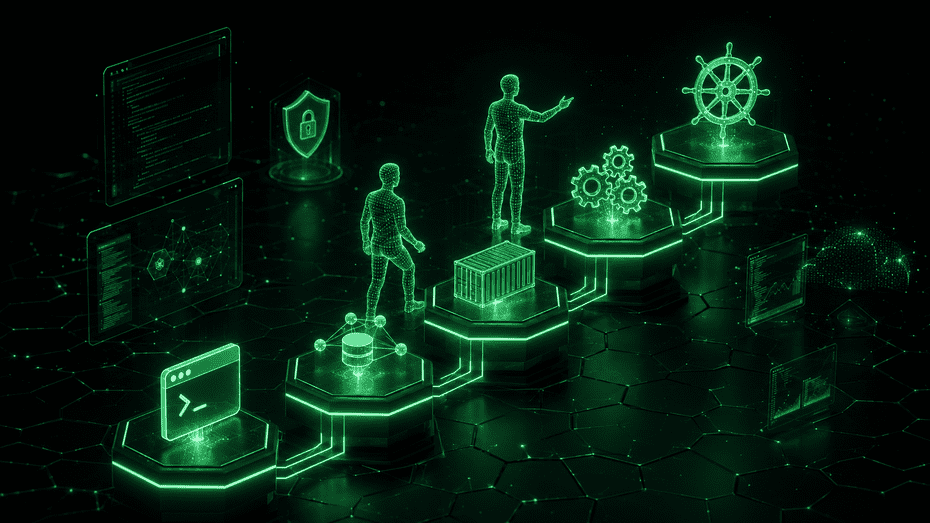
This need for transformation also underpins AI Factory, a framework developed by dvloper.io to standardize the components and processes that recur across AI implementation projects, from access to data and models and integration with existing systems to agent orchestration, identity and access management, security, observability, and outcome evaluation.
The goal is to enable organizations to move from experiments and proofs of concept to AI solutions that can operate effectively in production, without having to build every project from scratch.